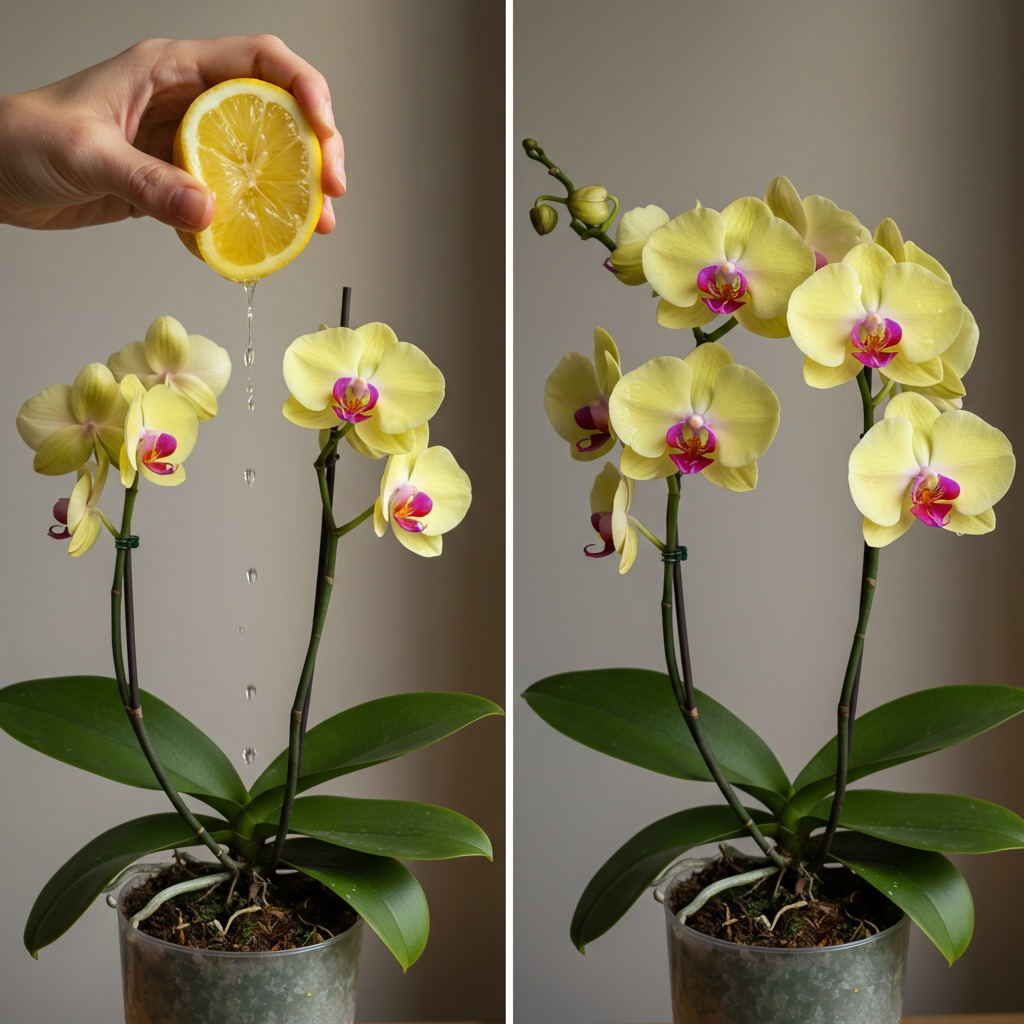
Making orchids thrive isn’t a problem, also thanks to lemon, a trick that helps keep them beautiful and healthy.
While the exotic nature and thinness of the orchid stem may cause some concern for their well-being, Phalaenopsis orchids are actually easy to care for.
Orchids, what a passion!
Phalaenopsis orchids are flowers of tropical origin that adapt very well as houseplants. Growing and maintaining orchids is very affordable, and they can bloom year-round.
Potted orchids on a windowsill
If you want abundant blooms, with bright green leaves and healthy roots, you must care for them with care and love.
Also, even if their flowers disappear, don’t be discouraged, as orchid flowers last a long time, and if the time comes to lose them, there are tricks to get them to bloom again.
Once the orchid flowers fall, you have three options: leave the flower spike (or stem) intact, cut it at a node, or remove it entirely.
If you opt for the third option, cut at the base of the plant. It’s definitely best if the stem starts to turn brown or yellow. This is a sign that it won’t produce flowers.
Removing the stem will shift the plant’s energy toward the roots, stimulating their growth. As a result, the plant will become healthier and the chances of new flowering peaks will increase.
Where to place orchids
At home, the orchid pot should be placed in an area that receives bright, indirect light with a temperature of about 24°C during the day and about 18°C at night.
It should also be watered weekly and fed once a month with a liquid houseplant fertilizer diluted to half strength.
Phalaenopsis orchids typically bloom once a year. To identify a new flower spike, look for upward-growing roots with bright green, rather than round, tips.
When a bloom peak appears, increase feeding to every two weeks with a liquid houseplant fertilizer diluted to half the recommended strength. Support the stem with a stem support as it grows.
lemon on plants
Even for those new to the naturalistic world of plants, having an orchid at home is possible, thanks in part to a few tricks involving the unusual use of a citrus fruit: the lemon. Let’s take a look at what it’s all about.
Well, yes, if you want to see good root production and beautiful blooms in our orchids, a completely natural solution is to use lemon juice! Surprised? Apparently, lemon is an excellent fertilizer not only for our orchids, but also for outdoor plants such as azaleas, hydrangeas, and camellias.
This fragrant citrus fruit is full of benefits not only for humans but also for plants. Obviously, you shouldn’t use plain lemon juice; instead, you should first squeeze the lemon juice and then dilute it in plenty of water. One liter might be enough to water the plant. This treatment should be done at least twice a week.
You can also pour the mixture into the saucer; this way, the plant will slowly and gradually absorb the lemon-treated water. This is useful for warding off insects such as mealybugs or thrips, as well as any disease threats that could reach the plant’s roots.
Clean the leaves
It is also possible to treat the leaves with cotton pads soaked in the freshly obtained liquid, taking care to squeeze them well so as not to damage the plant!
Also, if you want to keep insects away, simply spray a solution of lemon juice and vinegar (equal parts) on the plants, even around the pots, to keep ants away as well.
You can dry lemon peel and use it with fertilizer to add to your plants’ soil.
Orchids love small spaces and only really need to change their soil when it begins to decompose. That’s why it’s a good idea to use a good orchid mix containing bark, coconut fiber, sphagnum moss, and perlite.
You have to be very careful during the repotting phase; damage to the roots can be fatal and prevent flowering.